

100 Practical Tips for Broiler Poultry Farming
Follow these 100 expert-backed tips from leading poultry clinicians to improve your flock’s performance:
During farm preparation, using a veterinary detergent before disinfection is essential.
Nanoclean provides both washing and initial disinfection of the farm.
Remove weeds and unwanted plants around the farm and burn them.
Disinfect the areas around the barns using Desogerm.
Lime the farm area before chick placement.
Strong disinfectants reduce long-term costs by ensuring proper sanitation and lowering contamination-related mortality.
After washing, disinfect the barns using Despadak 5-in-1.
After initial washing, soak all tools in 2% Nanosil Farm for disinfection.
No rinsing is needed after disinfecting equipment with Nanosil.
Before chick arrival, disinfect the entire barn again with Nanosil Farm to remove secondary contamination.
Fill all pipes with 2% Nanosil Water solution and flush after 4 hours with high pressure.
Biofilm causes pipe corrosion, constant water contamination, and reduced vaccine and medication efficacy.
During the cycle (except during vaccination), use Nanosil Water – 50 ml per 1000 L water to disinfect water and control biofilm.
Feed and water contamination is a major cause of E. coli infection (Colibacillosis).
Disinfect feed using Nanosil Feed & Air at minimal cost.
Contaminated feed reduces vaccine response, causing low titers and high mortality.
Microorganisms are opportunistic—they exploit even tiny lapses in biosecurity.
Changing shoes and clothes before entering the farm is mandatory.
Entry footbaths filled with Desogerm are essential.
Regularly disinfect your car interior with Nanosil spray.
After returning from poultry gatherings, disinfect hands and shoe soles with Nanosil spray before entering your vehicle.
CRD (Mycoplasma infection) can enter the farm through chicks, feed, equipment, and humans.
Proper disinfection, strict quarantine, and quality medications minimize CRD-related losses.
Tiamulin, Erythromycin, and Tylosin Tartrate are effective for CRD.
Kimia Tiamulin is a new product from Huvepharma.
Ideal production goal: 2800 g weight & 1.7 FCR at 42 days.
Biosecurity is crucial for controlling disease spread.
Biosecurity programs protect birds by keeping pathogens out.
Strong disinfection, quarantine, immune support, proper nutrition, and proper medication boost biosecurity.
Mycotoxins in non-disinfected feed reduce vaccine efficacy and cause disease outbreaks.
Viral infections cause mortality and open the door for opportunistic bacteria (E. coli).
CRD Complex = Mycoplasma + E. coli co-infection.
In the first 10 days, if no culture/antibiogram is available, Lincospectin is the most effective antibiotic.
Combined infections from CRD Complex, Colibacillosis, and viral diseases require antibiotic treatment.
Prevention is the only effective approach to viral diseases.
Strong disinfection, proper vaccination, and support for vital organs (liver, kidney, lungs, intestines…) significantly increase viral resistance.
Antibiotics must be consumed quickly after mixing.
Florfenicol remains stable for only 4 hours in water—longer exposure causes weak treatment and antibiotic resistance.
Hard water decreases antibiotic efficacy and promotes bacterial resistance.
Add vinegar before antibiotics to improve drug performance, according to water hardness:
Hardness ≤ 250: 2 L / 1000 L
250–500: 4 L / 1000 L
500–750: 6 L / 1000 L
Enro-Sodium is more potent and dissolves better in hard water than regular Enrofloxacin.
Doxycycline is ideal when kidney-involvement diseases are present.
FLOREN is the only licensed Florfenicol product in Iran.
Kimia Flor’s higher efficacy comes from its formulation identical to FloRen.
Kimia Colistin Liquid follows European formulations, ideal for diarrheal outbreaks.
Heat stress, poor appetite, and coccidiosis are common summer problems.
Apply white lime to barn roofs to reduce temperature.
Kimia Plus instead of sugar water improves early chick performance and reduces heat stress.
Kimia Plus reduces heat-induced diarrhea.
Multielectrolytes prevent mortality during heat stress and diarrhea.
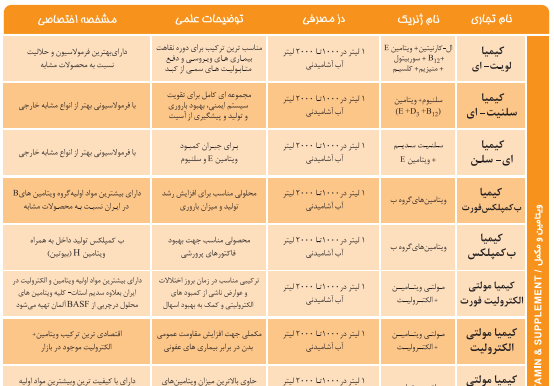
Kimia multielectrolytes include 5 salts instead of 4, plus vitamins.
Higher vitamin counts and doses make vitamin therapy more effective and economical.
Kimiafaam uses European-grade vitamins and solvents.
Check labels and compare vitamin content before purchase.
More ingredients & higher dosages = stronger effect & better cost-efficiency.
Heat stress increases the need for vitamin C.
Kimia AD3EC has 50% more vitamin C, ideal for hot seasons.
Effervescent Carbasalate + Vitamin C reduces fever, pain, inflammation, and supplies vitamin C.
Each 200 g pack treats 500 L, more economical than aspirin + C.
Kimia Meril stimulates appetite and supports the digestive system.
During reduced feed intake, Kimia Plus prevents weight loss and growth delay.
Kimia Strong Multivitamin compensates stress and nutritional deficiencies.
High humidity with reduced heating increases the risk of coccidiosis.
Strong disinfection with Despadak and Nanosil reduces coccidiosis risk.
Low-quality anticoccidials increase coccidiosis outbreaks.
Poor anticoccidials cause resistance to other anticoccidials.
Kimia Salinomycin is microgranulated and produced under a top European license.
Clinacox is the only imported Diclazuril approved by FDA & EU.
Clinacox is heat-stable and compatible with antibiotics in feed.
Kimia Amprolium is produced by Huvepharma.
Sulfa-Verdin with added vitamin K improves coccidiosis recovery and reduces bleeding.
AD3EK3C contains 7× more vitamin K than similar products—ideal for Gumboro & coccidiosis.
Kimia Plus improves anticoccidial performance.
Early chick mortality often results from unabsorbed yolk sac.
Temperature fluctuations during transport or early brooding impair yolk absorption.
Rapid yolk absorption delivers maternal antibodies and fat-soluble vitamins, reducing yolk sac infection.
Kimia Carnovite B supports yolk absorption and reduces week-one mortality.
Immune system strengthening is required throughout the grow-out period.
Before & after physical vaccination, Kimia Physioll reduces stress and boosts antibody levels.
Multi–amino acids improve antibody titers after vaccination.
Check amino acid count & concentration before purchase.
Most products have only 4–5 amino acids.
Kimia Stimol contains 17 amino acids and high-vitamin content—1 L per 300 L water.
Permotor is the world’s strongest B-Complex amino acid product: 1 L per 4000 L.
Every extra gram gained in week 1 = 7 g more at final weight.
Using Stimol or Permotor during week 1 increases final body weight.
Kimia Livet E supports immunity, detoxifies the liver, and helps recovery from viral diseases.
Kimia Selenium-E & E-Selen strengthen immunity and prevent viral disease susceptibility.
E-Selen has 10× more selenium than foreign products.
Leg weakness is a major reason for poor growth and culling.
Kimia Ligo contains 10 trace minerals—ideal for preventing deficiency-related leg issues and boosting immunity.
Kimia Hepatisho reduces toxicity effects, supports kidneys during IB/Gumboro, improves liver performance, reduces ascites, and is ideal before/after antibiotics.
European solvents used in Kimia vitamins improve intestinal absorption.
At signs of respiratory noise, use Bromhexine.
Using 0.5–1 L Nanosil per 1000 L water reduces disease spread.
After antibiotics and during early brooding, probiotics improve performance.
BioYeast, a top global probiotic from Kanzy (Canada), will soon be released.
Kimia B-Comphex contains extremely high B vitamins and is the only product containing biotin.
Using high-quality medications protects your investment and improves flock performance.
Permotor-L contains 17 amino acids + B vitamins, highly economical, used at 1 L per 4000 L water.
Key Points on Applied Poultry Nutrition
Poor storage conditions, long storage periods, and improper pre-harvest handling increase the likelihood of mycotoxin contamination in grains, especially corn.
Moisture above 13%, temperatures between 10–40°C, and pH 4–8 are ideal conditions for mold growth.
Major negative effects of mycotoxins in poultry include immune suppression and diarrhea.
Pelleting feed does not stop mold growth; it only delays it.
Fungi, yeasts, and bacteria are all potential feed contaminants.
Animal protein sources have the highest risk of Salmonella contamination.
A negative Salmonella test from a submitted feed sample does not guarantee its absence in the entire feed batch.
The most important plant-based protein source for poultry is soybean meal.
Low-quality protein sources create metabolic stress, are poorly digested, and undigested fractions increase litter moisture and worsen performance.
Poor-quality feed reduces growth, increases FCR, worsens carcass quality, suppresses immunity, and lengthens production cycles.
Anti-nutritional factors in soybean meal—due to insufficient heat treatment—impair amino acid absorption.
Excessive heat in oilseed processing (e.g., soy) reduces lysine digestibility, followed by cysteine.
Non-starch polysaccharides increase amino acid losses through fecal excretion.
Lysine is considered the reference amino acid; all others are compared against it.
Always prioritize lysine, methionine, methionine + cysteine, and threonine in formulation.
After lysine and methionine, threonine is the next limiting amino acid.
Diets containing meat meal are often limited by tryptophan and sulfur-containing amino acids.
Increasing dietary threonine enhances villi length, width, and depth.
Threonine helps balance amino acids and reduces feed costs.
Modern broilers require specific amino acid levels, not crude protein levels.
Excess absorbed amino acids are burned for energy and their nitrogen excreted—balancing amino acids reduces nitrogen excretion and improves profitability.
Trypsin inhibitors are major anti-nutritional factors in soybean.
Arabinoxylans in wheat can absorb up to 10× their weight in water and impair nutrient digestion.
Biotin digestibility from wheat is very low for poultry.
Biotin deficiency may cause fatty liver syndrome.
Cottonseed meal in layer diets causes yolk discoloration due to gossypol.
Iron sulfate counteracts the negative effects of gossypol.
Poor-quality fish meal can cause thiamine deficiency in young birds.
Anti-coccidial drug amprolium may cause thiamine deficiency in young flocks.
Cysteine deficiency causes poor feathering or feather loss.
Six months after vitamin premix production, vitamin K content may drop below 10%.
Slower digesta passage does not always mean improved digestibility.
In flocks exposed to mycotoxins, adding methionine is essential.
The most important minerals for poultry are calcium and phosphorus.
Electrolyte balance (Na, K, Cl) is critical in broilers.
Optimal FCR requires proper development of the immune, cardiovascular, respiratory, and skeletal systems.
Insufficient feeder space reduces growth and flock uniformity.
Adjust feeder height daily so that the bird’s back aligns with the feeder rim.
Feed and water must be easily accessible during the early brooding phase.
Chicks should not have to travel more than one meter to reach feed or water in the first days.
Before chick placement, verify uniform feed and water distribution throughout the house.
Chick boxes should be emptied promptly, gently, and uniformly at placement.
Empty chick boxes must be removed from the house immediately.
Leave chicks undisturbed for 1–2 hours so they can find feed and water.
After 1–2 hours, check temperature, humidity, feed, and water—and correct as needed.
Cold litter reduces feed intake, slows growth, and decreases flock uniformity.
Feeding immediately after hatch increases body weight and intestinal weight.
The yolk sac accounts for 20% of chick body weight.
The yolk provides about 50% of energy and 43% of protein needs during the first days.
The yolk contains nutrients (25% protein, 25% lipids), water (50%), and antibodies.
Early feeding increases gut motility, physical pressure on the yolk sac, and absorption rate through the yolk stalk.
Stress causes vasoconstriction around the yolk sac, reducing nutrient and antibody absorption.
In the first 8 hours, supplying energy, reducing stress, and stimulating feed intake are essential.
Every 1 gram of extra gain in week one equals 6 grams at final market weight.
Chicks have their highest genetic growth potential in the first week.
The purpose of week one is to accelerate structural growth, promote feed intake, and maximize genetic potential.
During week one, gut growth is four times faster than body growth.
Maximum intestinal growth occurs during days 6–10 post-hatch.
Intestinal villi height doubles (200%) within the first 48 hours post-hatch.
After hatch, most protein and energy go toward gut development.
Probiotics in the first two weeks improve gut development and microbial balance.
Week one is extremely sensitive because chicks grow 400% in this period (from ~40 g to 160–200 g).
Water makes up 60–70% of chick body weight; a 20% loss is fatal.
Tonus test (Tonic immobility) is a key measure of chick quality.
In Cobb broilers, amino acid needs are calculated as a percentage of the Ross breed requirements across three production phases.
Crumble or pellet diets prevent selective feeding; birds consume a balanced nutrient mix.
Pellets slow digesta passage and increase nutrient absorption.
Pelleting enhances peristaltic movement and improves feed efficiency.
Pellets protect feed quality by reducing ingredient exposure to air.
Coarse feed stimulates gizzard activity, improves gizzard development, and enhances yolk absorption.
Crop fill evaluation indicates early feeding/watering success (hard crop = feed only; distended crop = water only).
Tips for “A Poultry Production Cycle with Kimiafaam Pharmaceutical Group”
The main goal of the first 10 days is proper early growth and receiving maternal immunity through the yolk.
Using Kimia Plus instead of sugar water in the first days improves chick performance and reduces heat stress.
Kimia Plus contains glucose along with phosphorus, potassium, sodium, and betaine.
Kimia Plus reduces the negative effects of diarrhea and heat stress.
One major cause of chick mortality in the first days is failure of yolk sac absorption.
Temperature fluctuations during transport, heat stress, cold barns, and cold litter can prevent yolk absorption and increase week-one mortality.
Rapid yolk absorption improves uptake of maternal antibodies and fat-soluble vitamins, reducing yolk infection mortality.
Kimia Carnovit B, containing B-complex vitamins, enhances yolk absorption and reduces week-one losses.
Kimia Hepatisho is an excellent formula for reducing toxicity effects, improving liver performance, and facilitating yolk absorption.
L-Carnitine improves liver performance and is present in Kimia Carnovit B and Kimia Hepatisho.
One cause of stunting and weak chicks is paralysis.
Kimia Ligo, containing 10 essential trace minerals, is the most complete formula for preventing and treating deficiency-related paralysis and strengthening immunity.
Common early deficiencies include B-complex vitamins and vitamin E with selenium.
E-Selen, a new Kimiafaam product, contains 10× more selenium than similar imported products.
The immune system needs support throughout the production cycle.
Before and after physical vaccination (injection, eye-drop, etc.), Kimia Physioul reduces vaccination stress, increases antibody levels, and supplies B vitamins.
Multiamino formulations such as Kimia Stimol Forte and Kimia Promotor help produce strong post-vaccination antibody titers and boost immune defense.
Kimia Levite-E supports immunity, detoxifies the liver, and is ideal during viral disease recovery.
Kimia Selenium-E and E-Selen contain 10× more selenium than imported alternatives.
Kimia Vit-C-Fort (AD3EC) provides 50% more vitamin C—ideal during stress.
Kimia Salat-C effervescent powder (Carbasalate + Vitamin C) reduces fever, pain, inflammation, and supplies vitamin C.
Its dosage—200 g per 500 L—offers better solubility and is more economical than aspirin + vitamin C.
During reduced feed intake, Kimia Strong Multivitamin helps offset stress effects and nutrient deficiencies.
Kimia Vit-5 (AD3EK3C), with 7× more vitamin K, accelerates recovery from bleeding issues.
At the first sign of respiratory sounds, use Kimia Menthol-Hexine.
Mentofort, a herbal solution with menthol and eucalyptus, enhances immune titers.
Diarrhea is one of the most common poultry problems.
Kimia Multi-Electrolyte Forte contains the highest levels of vitamins and electrolytes plus sodium acetate.
Coccidiosis is a major poultry disease—best controlled through preventive anticoccidial drugs.
Coxian 120G and Kimia Salino 12, containing salinomycin, are top choices—effective against coccidia and also antibacterial.
Clinacox (Diclazuril) is the only anticoccidial approved by the U.S. FDA and the European Union.
Clinacox is effective against all Eimeria species and has an anticoccidial index of 180 for all.
Clinacox has no drug interactions with any antibiotics.
Kimiafaam’s Diclazuril is unique for its extremely fine and uniform particle size—ideal for feed mixing.
The goal in the last growth phase (after day 30) is optimal growth and preventing carcass downgrade.
To compensate growth lag, use multivitamins and amino acids.
Kimia Promotor-L contains a full profile of 17 amino acids plus B vitamins and is highly economical (1 L/4000 L water).
Kimia Stimol Forte also contains 17 amino acids + multivitamins and is used at 1 L/3000 L.
For reducing carcass fat and preventing weight loss: use Kimia Meril, Kimia Hepatisho, and Kimia Carnovit B.
Using Kimia Plus before sending birds to slaughter helps retain intracellular water, provides needed glucose, and prevents carcass weight loss.
Key Points on “House Preparation”
Apply lime around the farm perimeter before chick placement.
Afdecol is a strong, cost-effective disinfectant for all surfaces.
Warm water enhances disinfectant efficacy.
After washing, disinfect houses with the five-component Despadak protocol.
A 0.5% Despadak solution eliminates most pathogens within 5 minutes.
If the house previously had Gumboro, use Despadak at 1:50.
Allow full drying before bringing in movable equipment.
Fumigate with formalin + KMnO₄ (20 g permanganate + 40 ml formalin per 2.8 m³, then ventilate after 24 hours).
Despadak remains highly active in hard water and effective for up to 3 months.
Disinfect all equipment in 2% Nanosil Farm—no rinsing needed.
Kimia TH+5 retains full efficacy down to –18°C and works even at very low concentrations.
Kimia GPC-Fort is formulated specifically for severe viral diseases in poultry.
Kimia HyProtek uses peracetic acid for high-power disinfection.
Kimia M-Cid contains triple the glutaraldehyde of typical competitors and remains potent for over 10 weeks.
Before chick placement, re-disinfect the entire house with Nanosil Farm.
Fill all water lines with 2% Nanosil Water for 4 hours, then flush strongly.
Biofilm damages water systems, contaminates drinking water continually, and reduces vaccine efficacy.
Throughout the flock (except vaccination days) use 50 ml Nanosil Water per 1000 L to control biofilm.
Contaminated feed or water is a major source of colibacillosis.
Disinfect feed with Nanosil Feed & Air at minimal cost.
Contaminated feed suppresses vaccine response and raises mortality.
Microorganisms exploit any lapse in biosecurity—zero tolerance for negligence.
Change clothes and shoes before entering the farm.
Disinfect footwear in a footbath filled with Dezogerm.
Routinely disinfect vehicle interiors with Nanosil spray.
After visiting other farms, disinfect hands and shoe soles with Nanosil before entering your vehicle.
CRD (mycoplasmosis) enters via chicks, feed, farm environment, and people.
Proper disinfection, quarantine, and quality medications minimize CRD losses.
Biosecurity programs aim to keep pathogens away from poultry entirely.
Strong disinfection plus correct vaccination boosts immunity and organ resilience.
In acute disease outbreaks, increasing Nanosil Water (0.5–1 L per 1000 L) reduces spread.
Using Nanosil Feed & Air for air sanitation releases additional oxygen and improves the birds’ oxygen availability.
From day 5 onward, air disinfection can begin.
Mist Nanosil Feed & Air diluted 1:100 twice daily to reduce microbial load safely without harming chicks.
Key Points on “An Informed Guide to Drug Selection and Factors Influencing Drug Quality”
A clinician’s success depends not only on accurate diagnosis but also on using reliable and effective medications.
Pharmaceutical formulation plays a major role in the effectiveness of any drug.
Several KimiaFam products are formulated using up-to-date technologies from companies such as Hipra, KRKA, and Janssen, and are produced with high-grade European raw materials.
KimiaFam maximizes the active ingredient content in its formulations.
The company produces unique pharmaceuticals under license from reputable European manufacturers.
Kimia Enro-Sodium offers superior absorption and efficacy due to its sodium form and performs similarly to LG’s Enro-Act.
Kimia Prim-48 requires no shaking before use because its solvent ensures perfect homogeneity.
Using advanced laboratory facilities, KimiaFam has reproduced and improved the quality and packaging of foreign products such as:
Kimia PhysiOL (Metaphylsol)
Kimia Plus (Almaril Plus)
Kimia Meril (Neomeril)
Kimia Ligo (Mixoligo)
Kimia Stimul (Amprosol)
Kimia Stimul Forte contains the highest levels of amino acids and multivitamins among comparable products (17 amino acids + 11 vitamins).
Promotor-L, a fully European product, is extremely concentrated — 1 liter treats 4,000–8,000 liters of water.
Despadac, a Spanish-made disinfectant containing five active agents, is the strongest disinfectant available.
Floron is the only Florfenicol in Iran produced under KRKA’s license.
Kimia Doxy-S uses European formulation and premium raw materials, giving it higher quality than similar market products.
Clinacox is the only European (Janssen Belgium) Diclazuril available.
Kimiafaam uses Cremophor as the solvent for its multivitamin solutions, providing unmatched solubility.
Kimiafaam’s Salinomycin (Coxisan 120-G) is produced under KRKA license.
All products are manufactured with the best available raw materials.
Kimia Hepatisho is formulated using artichoke extract from the Bernet company.
Kimia E-Selen contains the highest vitamin E and selenium content compared to similar products.
The effervescent form of Kimia Salat-C dramatically improves solubility.
The active ingredient of Kimia Amprolium comes from Sintofarm (Italy).
Kimia Moline-S, Moline-45, and Kimia Lozin are formulated using raw materials from Huvepharma (Europe).
Kimiafaam liquid drug bottles include measurement cups for ease of use.
Bottle caps include an air-buffer design that prevents heat-shock damage.
Bottles are made from premium-quality materials.
Powdered products use multi-layer pharmaceutical-grade packaging to prevent moisture penetration.
KimiaFam’s R&D team continually raises product quality.
Their scientific team includes top experts in pharmacology, livestock health, poultry nutrition, and management.
According to users across the country, Kimiafaam’s product quality is unmatched and holds the highest sales record.
The company benefits from a vast and efficient distribution network.
The best product for yolk sac absorption is Kimia Carnovit-B.
Kimiafaam imports top global probiotics and prebiotics from Kenzy (Canada).
Mentofort, a 100% herbal bronchodilator (eucalyptus + mint), is one of the most effective supportive treatments for respiratory diseases.
Nanosil Water, Feed & Air remains stable across different pH levels and temperatures.
Nanoclean simultaneously washes and performs initial disinfection because it contains antimicrobial components.
Using Nanosil Farm requires no rinsing after disinfection.
Kimia Vit-5 (AD3EK3C) contains seven times more vitamin K3 than similar products, making it significantly more effective in clotting support.
Sulfaverdin Forte contains vitamin K in its solvent, making it superior in treating coccidiosis.
Kimia Multi-Electrolyte Forte contains the highest vitamin and electrolyte concentrations; its sodium acetate helps regulate body pH and prevents alkalosis/acidosis during diarrhea.
Kimiafaam imports all raw materials from reputable European manufacturers and follows modern pharmaceutical formulation standards.
Chlortetracycline Spray is used for skin wounds and secondary infections caused by external parasites.
Dichlorophen Spray is effective for preventing and treating hoof rot, ringworm, and superficial wounds.
Liqoderm is used for dermatitis, follicular disorders, eczema, and all ringworm-type fungal infections.
Electro-Balance Powder is a top option for restoring electrolyte balance under heat stress or disease.
Su-Hazemeh Powder effectively treats digestive disorders, boosts appetite, and supports general health.
Diar-Stop Powder, with its organic components, is one of the best treatments for diarrhea.